Atlas eco-lodges: Berber accommodation in Imlil, Ourika and Ifrane
What are the best eco-lodges in the Atlas Mountains?
Kasbah du Toubkal in Imlil is the benchmark — solar-powered, Berber-managed, spectacular Toubkal views from €100-220/night. In Ourika Valley, Kasbah Bab Ourika and Douar Samra lead. Ifrane has limited true eco-lodge options but Michlifen Resort's sustainability credentials are improving. Budget eco-stays in Imlil start from €35/night at Berber guesthouses.
Why the Atlas Mountains offer Morocco’s most authentic lodging
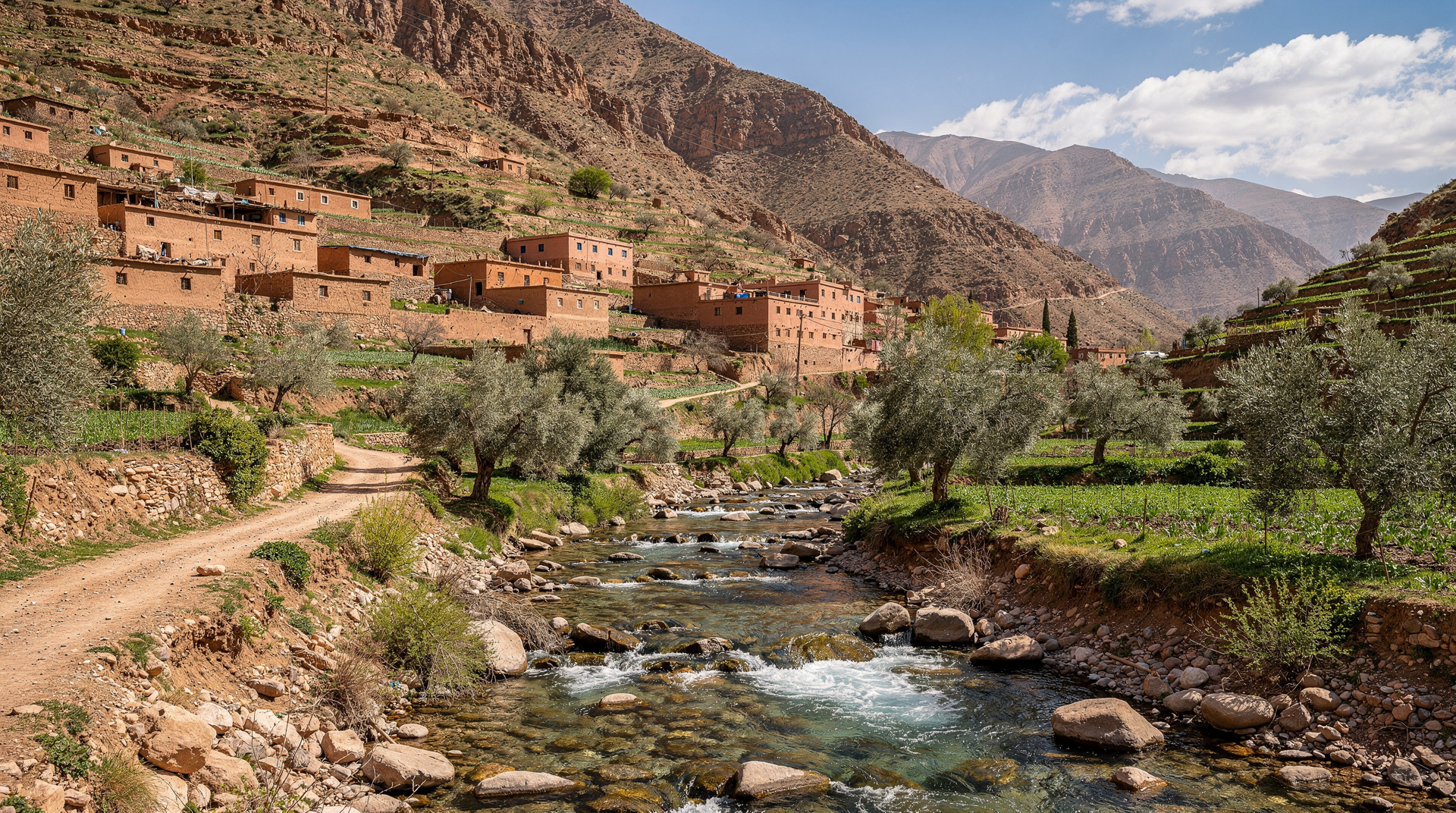
The High Atlas Mountains were home to Berber communities long before tourism reached Morocco. The accommodation scene that has developed — particularly in Imlil, the Ourika Valley, and the Middle Atlas around Ifrane — reflects this: most properties are built from local stone and cedar, managed by Berber families, and powered partly or entirely by solar and hydro systems that work with mountain resources rather than against them.
This is not the curated eco-branding of urban wellness resorts. It’s the pragmatic sustainability of remote communities that have always had to work with what the landscape provides. The result, for visitors, is accommodation that is genuinely different from anything available in the cities — and which supports local livelihoods directly.
This guide covers the best eco-lodges and Berber guesthouses across three Atlas regions: the Imlil valley (gateway to Jebel Toubkal), the Ourika Valley (closest Atlas valley to Marrakech), and the Middle Atlas around Ifrane.
| Where | Imlil (Toubkal), Ourika Valley, and Ifrane/Middle Atlas |
| Cost | Roughly €35–95/night budget-to-mid, €100–450/night for the flagship lodges |
| Time needed | 1–2 nights minimum to feel the difference from a day trip |
| Getting there | Grand taxi or private transfer from Marrakech (Imlil, Ourika) or Fes (Ifrane) |
| Best time | Spring (blossom) and autumn for Imlil/Ourika; winter for Ifrane’s snow |
Imlil: the Toubkal base and its accommodation
Imlil sits at 1,740m altitude, 63km south of Marrakech (90 minutes by road, then a short walk). It’s the primary base for climbs of Jebel Toubkal (4,167m, North Africa’s highest peak) and for day hikes in the Toubkal National Park. The village has seen significant tourism development since the early 2000s but remains genuinely small and Berber-operated.
Kasbah du Toubkal
The benchmark eco-lodge in Morocco and one of the most recognised sustainable tourism operations in Africa. Built into a former fortified house (kasbah) above Imlil village, Kasbah du Toubkal has been operating since 1995 under a partnership model that shares revenue with the Imlil community — a genuinely meaningful arrangement rather than marketing language. A percentage of every booking goes to community projects (a Berber school, hammam, and public facilities).
The lodge is solar-powered with limited generator backup. Rooms are basic by luxury standards — locally woven textiles, traditional clay plasterwork, no TV — but the quality of what matters is high: mattresses, bedding, and the extraordinary view of Toubkal from the terrace.
The food is Berber mountain cuisine: tagines cooked in clay pots over wood fires, fresh bread from the communal oven, and honey from local hives. Dinner is communal — you eat with other guests at shared tables, which suits solo travellers and those open to meeting people. If you want private dining, ask when booking.
Price: €100–220 per person per night (includes dinner and breakfast in most room categories) Standout: Community model, Toubkal view, food quality, genuine sustainability credentials Limitation: Not luxury by international standards; rooms are traditional and functional; the walk from the road requires 15 minutes uphill
Getting there: Shared grande taxi from Marrakech to Asni (1 hour, ~100 MAD), then another taxi to Imlil (30 minutes, ~50 MAD per seat), then 15-minute walk uphill to the lodge. Or private transfer from Marrakech (90 minutes, ~€35-45).
Dar Imlil
A smaller property (8 rooms) in the lower village. Less elevation than Kasbah du Toubkal but easier to reach and better for families or those with limited mobility. The rooftop terrace has good valley views rather than the summit-level drama of the Kasbah. Solar hot water, locally sourced food. A reliable mid-range option.
Price: €65–95/night Standout: Easier access, family-friendly, reliable service Limitation: Lower altitude means less dramatic views
Riad Dar Ifoulki
A small guesthouse (6 rooms) run by a Berber family from the village. The most basic property in this section and the most authentically family-operated. Guests share a communal salon for tea and meals, rooms are simple, and the price reflects this. An excellent option for trekkers who want genuine community contact rather than a polished experience.
Price: €35–55/night (meals available separately) Standout: Family atmosphere, lowest price, genuine community immersion Limitation: Basic rooms; no private bathroom in some configurations
Budget trekking accommodation in Imlil
Imlil has several gîtes (trekking guesthouses) that cater to hikers doing multi-day Toubkal treks. These are functional rather than characterful — dorm beds from €15/night, basic private rooms from €30/night — and serve as overnight stops rather than destination stays. The local CAF (Club Alpin Français) refuge on Toubkal itself is at 3,207m and costs around €15/person for a dorm bed.
For the Toubkal trek guide which covers the full approach and what to expect at each stage, and the Imlil day trip from Marrakech guide for those combining a day visit rather than an overnight, refer to those dedicated pages.
Ourika Valley eco-lodges
The Ourika Valley runs southeast from Marrakech for about 60km before rising into the Atlas Mountains. It’s accessible year-round (unlike the Toubkal area, which has snow closures November-April at higher elevations) and close enough to Marrakech (1 hour) for day trips. Several eco-lodges have established themselves along the valley in the past decade.
Kasbah Bab Ourika
The most polished eco-lodge in the Ourika Valley. Built on a hillside above the valley floor at 1,100m, Kasbah Bab Ourika has 12 rooms and suites, an infinity pool overlooking the valley, and a restaurant that uses produce from the garden and local farms. The building uses traditional pise (rammed earth) construction — thermally efficient and locally sourced materials.
The sustainability commitment here is genuine: solar water heating, minimal plastic, food sourcing from nearby villages. Staff are largely local.
Price: €180–350/night (suite and pool villa categories available) Standout: Infinity pool with valley views, design quality, sustainability credentials Limitation: Expensive by valley standards; some suite categories have limited natural light
Douar Samra
A 5-room guesthouse and sustainable tourism project in the village of Setti Fatma, near the Ourika Waterfalls at the valley’s end. The project is managed in partnership with local women’s cooperatives — argan oil, woven goods, and local food are sourced from village producers. The property is simple but purposeful.
Price: €55–85/night Standout: Community project model, access to waterfalls trailhead, authentic village setting Limitation: Basic accommodation; shared bathrooms in some configurations; limited WiFi signal
Staying in Ourika: what to expect
The valley itself is best in spring (February-May) when almond and cherry blossom cover the terraced slopes, and in autumn (September-October) for clear skies and comfortable temperatures. July and August bring Marrakech day-trippers in large numbers — accommodation in the valley books out, prices rise, and the road can be congested.
For those doing a day trip rather than overnight, the Ourika Valley day trip from Marrakech section covers transport and the waterfall circuit. The Ourika Valley day trip with lunch packages the transport and a traditional lunch at a valley restaurant.
Ifrane and the Middle Atlas
Ifrane is Morocco’s Alpine-styled city, built by the French protectorate in 1929 as a highland resort. It sits at 1,665m in the Middle Atlas, 65km south of Fes. The cedar forests here are home to Barbary macaques (wild monkeys), and winter brings enough snow for the small ski station at Mischliffene.
True eco-lodges in the Ifrane area are fewer than in the High Atlas. The region is more developed — Ifrane itself is a planned city rather than a traditional village — and the accommodation scene reflects this.
Michlifen Resort and Golf
The main luxury property in the Ifrane area. 53 rooms, spa, ski access in winter, and forest walks in summer. The “eco” credentials here are partial — the resort has invested in energy efficiency and water management but operates at a scale that inherently has environmental impact. Worth being honest: this is a luxury mountain resort with sustainability investments, not a grassroots eco-lodge.
Price: €200–450/night Standout: Quality facilities, ski access, forest walks Limitation: Resort scale; less authentic than smaller properties
Guesthouses in Azrou and Ain Leuh
The villages of Azrou (25km from Ifrane) and Ain Leuh (40km) have traditional Berber guesthouses that offer far more authentic Middle Atlas experiences than Ifrane itself. Prices are modest (€30-60/night), breakfast is Berber mountain fare, and the cedar forest walks — where macaques can be seen in their natural habitat — start from the village edge.
Azrou guesthouses: Several family-run properties along the main road; look for Dar Ben Arfa and similar names on regional booking platforms. Confirm heating in winter (essential — temperatures drop below 0°C from November to February).
Atlas eco-lodge comparison table
| Property | Location | Altitude | Price/night | Sustainability | Best for |
|---|---|---|---|---|---|
| Kasbah du Toubkal | Imlil | 1,850m | €100–220 | Excellent (community model) | Toubkal trekkers, authenticity |
| Dar Imlil | Imlil village | 1,740m | €65–95 | Good | Families, day hikers |
| Riad Dar Ifoulki | Imlil | 1,740m | €35–55 | Good | Budget, genuine contact |
| Kasbah Bab Ourika | Ourika Valley | 1,100m | €180–350 | Good (rammed earth, solar) | Couples, design-conscious |
| Douar Samra | Ourika, Setti Fatma | 1,550m | €55–85 | Excellent (co-op model) | Community-focused travellers |
| Michlifen Resort | Ifrane area | 1,600m | €200–450 | Partial | Ski, luxury comfort |
Sustainable tourism in the Atlas: what it means in practice
The term “eco-lodge” is used loosely in Morocco. What distinguishes genuine sustainability from marketing:
Energy: Solar water heating is standard at better properties. Solar electricity generation is less common but growing. Kasbah du Toubkal uses solar exclusively; Kasbah Bab Ourika uses solar water heating with grid connection.
Water: Water is scarce in the Atlas, particularly in summer. Properties that recycle greywater for garden irrigation and restrict laundry frequency for stays under 3 nights are making a meaningful difference. Ask about water practices if this matters to you.
Food sourcing: The best lodges source food from nearby villages — argan oil from local cooperatives, vegetables from valley gardens, honey from mountain hives. This is verifiable: ask where ingredients come from.
Employment: Community employment is the most straightforward indicator of sustainability. Kasbah du Toubkal’s community partnership model is the most developed example — over 80% of employees are from Imlil.
Building materials: Traditional pise (rammed earth), local stone, and cedar from certified sources are preferable to imported concrete and steel. Most of the properties in this guide use traditional materials at least in part.
For broader context on trekking and hiking in the Atlas, the hiking and trekking guides cover the main trails. The Imlil day trip from Marrakech covers the short excursion option for those who want a taste without an overnight. The Atlas Mountains destination guide has the full regional overview.
For combining an Atlas stay with a desert experience, Merzouga vs Agafay explains how the Agafay desert (45 minutes from Marrakech) differs from the Sahara — useful if you want both mountains and desert on a single trip. The 7-day Morocco itinerary suggests a workable sequence.
A Berber village and Atlas Mountains day trip from Marrakech is the fastest way to see the landscape and understand what Imlil and the Ourika Valley offer before committing to an overnight — useful reconnaissance if you’re planning a longer Atlas stay on a return visit.
Berber culture and your eco-lodge stay
Staying in the Atlas means entering Amazigh (Berber) cultural territory. Roughly 14 million Moroccans identify as Berber, and the Atlas communities — particularly in Imlil and the Ourika Valley — maintain distinct customs, dress, and agricultural practices. Understanding a few things before your stay:
Language: The Atlas Berber dialect (Tachelhit) is widely spoken in Imlil and southern Atlas communities. Darija (Moroccan Arabic) is the second language. French works in most lodge settings. English is less common outside tourism-facing staff.
Hospitality ritual: In Berber homes and lodges, hospitality is expressed through tea ceremony — the three-pour Berber tea (strong first, sweet second, sweeter third) is a social ritual that you participate in rather than simply receive. Don’t rush it or decline it.
Food traditions: Berber mountain food differs from the tagine-and-couscous generalisation of Moroccan cuisine. In Imlil: slow-cooked lamb with preserved vegetables, thin flatbreads baked on a curved cast-iron disc (aghroum), and harira soup made with dried legumes from the previous year’s harvest. Kasbah du Toubkal’s kitchen operates this tradition rather than a tourist-adapted version.
Mule culture: In Imlil and the Ourika Valley, mules are the primary transport system for goods and heavy luggage on mountain trails. The relationship between Berber families and their mules is practical and genuinely important to mountain economics. Trekking operations that use mules should be compensating owners fairly — ask Kasbah du Toubkal about their mule hire practices, which are transparent.
What an Atlas eco-lodge stay looks like in practice
Arrival: Most lodge arrivals involve the same walk-in challenge as medina riads but vertical — a 10-15 minute uphill walk from the road. Kasbah du Toubkal has a team that meets arrivals at the road end and carries luggage up. Plan for this and don’t arrive with wheeled suitcases.
Evening: Dinner is communal at most Atlas lodges — you eat with other guests at shared tables. This is deliberate: the community atmosphere is part of the experience, and it creates natural connections between solo travellers and groups. If you genuinely want private dining, ask when booking.
Morning: Sunrise in Imlil is between 5:30am (summer) and 7:15am (winter). The Toubkal summit visible to the south catches the first light before the valley floor does — waking up before sunrise and watching the peak turn orange from the lodge terrace is the defining Imlil experience.
Activities from the lodge: Most properties can arrange guided hikes, mule-supported treks, and village visits. Kasbah du Toubkal has a partnership with a local guide cooperative — the guides are from Imlil, know the trails deeply, and speak English.
Practical preparation for Atlas eco-lodge stays
Packing for the Atlas: Even in summer, Atlas nights are cold (8-14°C in Imlil, lower at altitude). Bring a proper fleece or down layer — the lodges provide blankets but not warm outer layers. Hiking boots are strongly recommended for any trail walking; the terrain is rocky.
Payment: Most Atlas lodges accept card payment but may have connectivity limitations. Bring cash (MAD) as backup — there’s an ATM in Asni (30 minutes from Imlil) but not in the village itself.
Altitude: Imlil sits at 1,740m. The first day at altitude occasionally produces mild headaches or reduced appetite — symptoms that typically pass within 24 hours. Drink extra water on arrival day and don’t plan a strenuous hike for your first morning.
Weather: The Atlas gets genuine weather. October-November can bring early snow above 2,500m. November-March sees snow at lodge level in bad years. Spring (March-May) combines snowmelt waterfalls, wildflowers, and unpredictable afternoon cloud. Summer is the most reliable window for Toubkal summit attempts.
Combining eco-lodge stays with city visits
The Atlas works best as part of a wider Morocco itinerary rather than a standalone destination for most travellers. Natural pairings:
Marrakech + Imlil (2 nights): The most accessible combination — Marrakech for city exploration, Imlil for mountain recovery. The contrast between medina sensory overload and mountain quiet is significant and satisfying. This works on a 5-7 night total Morocco visit.
Marrakech + Ourika Valley (1 night): A shorter add-on that works even on a 4-night Morocco visit. Kasbah Bab Ourika is 1 hour from Marrakech; even a single night delivers the mountain experience.
Full High Atlas circuit: For dedicated trekkers, a 5-7 day Toubkal circuit combining Imlil lodges with mountain huts covers the full High Atlas experience. The Toubkal trek guide has the stage-by-stage breakdown.
The luxury Morocco itinerary includes an Atlas night at Kasbah du Toubkal or Kasbah Bab Ourika as a natural addition to a Marrakech-desert circuit. The 10-day Morocco itinerary shows where the Atlas fits within a more comprehensive country visit.
Booking timing and what to expect on arrival
Kasbah du Toubkal and Kasbah Bab Ourika book out well ahead for Friday and Saturday nights and through the spring blossom and peak summer trekking weeks — 4–8 weeks ahead is a safe margin for those two properties. Smaller family-run guesthouses in Imlil, Setti Fatma, and the Middle Atlas villages are far more flexible and can often be booked a few days out, or even arranged on arrival through a local guide.
Wifi is genuinely limited at altitude — most lodges have it in common areas only, and it drops during bad weather. This is a feature more than a bug for most guests, but plan ahead if you need to work. For the trek approach itself rather than the lodge stay, the Toubkal summit guide covers route logistics in more detail than this accommodation-focused page.
Frequently asked questions about Atlas eco-lodges
Do Atlas eco-lodges provide heating in winter?
Most do, but standards vary. Kasbah du Toubkal and Kasbah Bab Ourika have proper heating or wood-burning stoves in common areas and bedrooms. Smaller budget guesthouses in Imlil and the Middle Atlas may rely on extra blankets and a single stove in the salon — confirm heating specifically if visiting November–March, when nights genuinely drop below freezing at altitude.
Can I book an Atlas eco-lodge without also trekking Toubkal?
Yes. Imlil and Ourika lodges welcome guests who simply want the mountain setting, food, and views without a summit attempt — day walks around the village are enough for most non-trekkers. The Imlil day trip from Marrakech guide is useful if you want a taste before committing to an overnight stay.