Morocco's artisan cooperatives: where to buy fair and buy well
What are artisan cooperatives in Morocco and why should I buy from them?
Cooperatives are producer-owned organisations where artisans sell directly to buyers, cutting out intermediaries. Prices are fixed and transparent, quality standards are enforced, and a larger share of the sale price reaches the maker — often a rural woman who would otherwise have no formal income.
Buying craft in Morocco without the theatre
The souvenir industry in Morocco’s major cities has become highly theatrical — elaborate origin stories, tribal certificates of authenticity, mint tea and calculated hospitality, prices that start five times higher than what will eventually be accepted. This theatre exists because it works. But it leaves many visitors feeling uncertain about what they actually bought, who made it, and whether the price was fair.
Artisan cooperatives offer an alternative. Morocco has an extensive and growing cooperative sector — particularly in the argan oil, weaving, and pottery industries — where producers sell directly to buyers under fixed prices, with clear information about who made the item and how. The price you pay goes primarily to the artisan rather than to a chain of intermediaries.
This guide covers the most significant cooperatives, what they sell, where to find them, and what the cooperative model means in practice for visitors who want to shop with both quality assurance and social conscience.
| Where | Souss-Massa (argan), Marrakech and Anti-Atlas (weaving), Fes and Safi (pottery) |
| Typical spend | Around 60–300 MAD per item depending on category; fixed prices, no bargaining |
| Time needed | 30–60 minutes per cooperative visit, longer if combined with a demonstration |
| Getting there | Grand taxi, private driver, or as a stop on a longer road trip (Marrakech–Agadir, Atlantic coast) |
| Best time | Year-round; mornings are quieter and demonstrations are more likely to be in full swing |
Why cooperatives matter in rural Morocco
The cooperative movement in Morocco gained significant legislative momentum after 2010, when the government passed laws simplifying cooperative registration and providing tax incentives for cooperatives in disadvantaged regions. The International Labour Organization and various European development programs have also invested heavily in cooperative capacity-building, particularly for women’s groups.
The impact in concrete terms:
For rural women: Many of Morocco’s most isolated communities — High Atlas villages, Souss Valley argan groves, Rif Mountain weaving communities — have historically offered almost no formal income for women. Cooperative membership provides a registered business structure, a fair wage, and in many cases training in literacy, accounting, and quality standards.
For product quality: Cooperatives have a direct interest in maintaining quality because their reputation is their primary marketing asset. A bad product at a cooperative damages the entire organisation; at a souk stall, the vendor can simply move on to the next customer.
For the buyer: Fixed prices (no bargaining required), transparent provenance, and the knowledge that the purchase has a measurable positive impact.
Argan oil cooperatives
What they produce
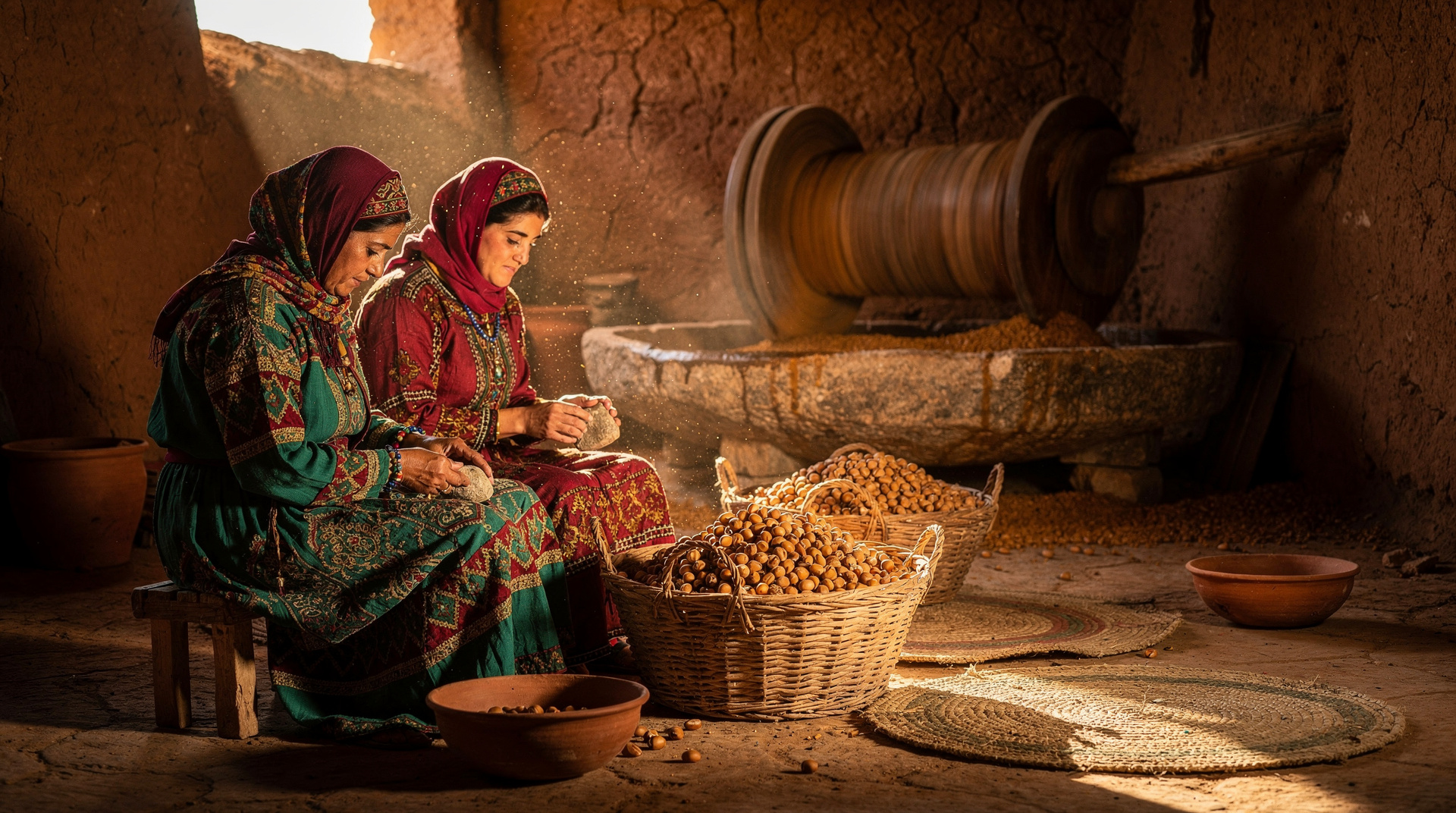
Argan oil is extracted from the kernel of the argan tree (Argania spinosa), a species endemic to the Souss-Massa region of southwestern Morocco between Agadir and Essaouira. The extraction process is labour-intensive — the fruit is dried, the pulp removed, the hard shell cracked to extract the kernel, and the kernels pressed to extract the oil. One litre of argan oil requires approximately 30kg of fruit and 8–12 hours of hand labour.
Two types of argan oil are produced:
- Cosmetic-grade (cold-pressed, unroasted): Used in skin care, hair treatment, and nail care. Lighter in colour, no smell. The argan oil that appears in premium European cosmetics.
- Culinary-grade (lightly roasted): Used in Moroccan cooking, particularly amlou (almond-argan-honey paste) and as a finishing oil on couscous. Darker, nutty smell, richer flavour.
The cooperative experience
Visiting an argan cooperative is one of the more genuine craft-process experiences available in Morocco. The cooperatives typically have a demonstration area where you can watch women cracking argan nuts (a slow, precise skill — the nut must be cracked without crushing the kernel) and pressing the oil by hand or with small mechanical presses.
The demonstration is not performance — the women are doing their actual daily work. Questions are welcome, and most cooperatives have bilingual staff.
Key cooperatives
Cooperative Aït Ismaïl (Ait Melloul, near Agadir): One of the larger certified cooperatives in the Souss region. Sells cosmetic and culinary argan oil, amlou paste, and argan-based cosmetics. Fixed prices, EU export certification.
Ajdigue Taliouine (Taliouine area): Taliouine is Morocco’s saffron capital (the Taliouine valley produces some of the world’s best saffron alongside argan production). This cooperative produces both argan products and premium-grade saffron. Worth a detour if you are travelling between Agadir and Ouarzazate on the N10.
Cooperative Tilila (near Essaouira): Located along the Agadir-Essaouira road, one of the most accessible cooperatives for visitors doing the Atlantic coast circuit. Sells cosmetic argan oil, culinary oil, and argan-based cosmetic products. Has been certified by the European Union for export quality standards.
Cooperatives along the P2040 road (Marrakech–Agadir): Dozens of smaller cooperatives line the argan forest belt. The quality certification varies — look for cooperatives with UCEFA (Union des Coopératives des Femmes de l’Arganier) membership or European organic certification labels.
Price benchmarks for argan oil (genuine cooperative quality)
- Cosmetic argan oil, 30ml: 60–100 MAD
- Cosmetic argan oil, 100ml: 180–280 MAD
- Culinary argan oil, 250ml: 150–220 MAD
- Amlou paste (argan, almonds, honey), 250g: 80–150 MAD
These prices are significantly higher than souk argan oil, which is frequently adulterated or entirely different oil with a drop of argan for scent. Genuine cooperative argan oil at these prices represents fair value for a genuinely rare and labour-intensive product.
Weaving cooperatives
Amal Marrakech
Amal (“hope” in Arabic) is Marrakech’s most well-known social enterprise, established to train and employ women in difficult circumstances — domestic violence survivors, divorced women without income, single mothers. Amal operates as both a restaurant (famous for its generous Moroccan lunches) and a craft cooperative selling traditional textiles.
The textile products include embroidered cushion covers, hand-woven table runners, traditional Moroccan clothing items, and decorated household linens. All products are made by cooperative members at fair wages. The quality is consistently good — the organisation’s survival depends on it.
Location: Multiple training restaurant locations in Marrakech’s Guéliz district. The craft shop is located at the Amal Women’s Training Center. Check the current address (they have moved and expanded multiple times) at their website or ask your riad.
What to buy: Embroidered table linens, hand-woven cushion covers, traditional djellabas. Prices are fixed and honest — a quality embroidered cushion cover: 150–300 MAD.
11 Nissan Marrakech
Named for Morocco’s Day of Youth (April 11th), this Marrakech-based cooperative employs women from the medina to produce traditional zellige-pattern embroidery, woven items, and decorated household textiles. Less well-known than Amal but respected for quality and consistency of product.
Location: Northern medina area — ask at a riad for current directions or check Google Maps for updated location.
Cooperative Tissage de Tilmi (Anti-Atlas)
Located near Tafraoute in the Anti-Atlas mountains, this cooperative produces the distinctive indigo-and-cream woven textiles of the Chleuh Berber tradition. The geometric weaving patterns differ from High Atlas styles — bolder, simpler, with a graphic quality that photographs extremely well. Sold through the cooperative workshop and through several fair-trade shops in Agadir.
What to buy: Woven blankets, kilim-style flat-weave carpets, table runners.
Cooperative Femmes de Berbère (Middle Atlas)
Based in the Khénifra area of the Middle Atlas, this cooperative produces traditional Zayane Berber weavings — heavy wool pieces with geometric patterns in natural wool colours. These are the precursors to the more commercially known Beni Ourain style. For the full background on Berber rug types, see the Berber rugs guide.
Shipping and getting your purchase home
Larger items — rugs, blankets, ceramics — are the main headache. Most established cooperatives can arrange shipping, but the service varies enormously in reliability. Ask for a written quote and an estimated delivery window before paying, and get a receipt that itemises what was shipped. For smaller items (argan oil, amlou, small textiles), airline hand luggage rules apply: liquids over 100ml go in checked baggage, so a 250ml bottle of culinary argan oil needs to travel in your suitcase, well wrapped.
If you are travelling on to the Sahara desert or the Atlas Mountains after a cooperative stop, buy pottery and glass last — it rarely survives several more days of travel in a backpack.
How this fits with souk shopping generally
Cooperatives are not a replacement for souk shopping — they are a complement. The souks remain the place for volume, variety, and the theatre some travellers genuinely enjoy; cooperatives are the place for a smaller number of purchases where provenance and fair pay matter more than the haggling experience. Many visitors do both: a cooperative for one or two considered purchases (a rug, a case of argan oil to bring home), and the souks for everything else. If bargaining culture itself interests you, it is covered in more depth in the Marrakech souks guide.
Pottery cooperatives
Aïn Nokbi cooperative workshops (Fes)
The Aïn Nokbi potters’ village in Fes functions as a loose cooperative where member workshops share kiln access, marketing, and the AOG (Appellation d’Origine Géographique) label for Fes pottery. The individual workshops sell directly to visitors at transparent prices. For full detail on visiting Aïn Nokbi, the Fes blue pottery guide is the dedicated resource.
What to buy: Hand-painted blue-and-white Fassi ceramics, zellij tiles, decorative platters.
Safi Pottery Cooperative
Safi, the pottery capital of the Atlantic coast, has a significant cooperative sector producing its distinctive earthy-coloured ceramics. The Colline des Potiers (Potters’ Hill) area contains dozens of cooperative kilns where visitors can watch the entire process from clay to finished pot. Safi pottery uses locally sourced clay and traditional wood-fired kilns, producing a different aesthetic from the Fes blue style — rougher, more earthy, with painted birds, fish, and leaf motifs in ochre, green, and brown.
Location: On the N1 coastal road between Casablanca and Essaouira. An easy stop on the Atlantic coast road trip.
How to find cooperatives in Morocco
UCEFA (Union des Coopératives des Femmes de l’Arganier): Lists certified argan cooperatives in the Souss-Massa region with quality certification information.
Marjane and Mohammed VI Foundation cooperatives: The royal foundation has supported establishment of certified cooperatives in most provinces — a list is available through tourist offices in major cities.
Google Maps search: Searching “cooperative artisanal” or “coopérative femmes” in any Moroccan city will surface local results with reviews.
Your riad: Riad staff often know which local cooperatives are genuine versus which are cooperative-branded shops with normal souk commercial dynamics.
Fair-trade shops in medinas: Several fair-trade shops in Marrakech, Fes, and Essaouira source directly from verified cooperatives and display the provenance of their goods. These shops charge slightly more than buying directly from a cooperative but offer a curated selection from multiple producers.
What the cooperative model means in practice
The word “cooperative” has been adopted by some commercial souk operations as a marketing label without the underlying ownership structure. Here is how to distinguish a genuine cooperative from a shop using the word commercially:
Genuine cooperative characteristics:
- Fixed prices (no negotiation)
- Posted information about the cooperative membership and mission
- Visible production or clear provenance labelling
- Cash register with receipts
- Staff who can explain who made a specific product
Red flags:
- “Cooperative” signage but aggressive price negotiation
- No production visible or explained
- Generic product range indistinguishable from main souk stalls
- Pressure tactics
Combining cooperative visits with an itinerary
Marrakech base: Amal Marrakech and the Ensemble Artisanal (government cooperative market near Bab Nkob) are both accessible from the city centre. The argan cooperatives along the Marrakech–Agadir road are a 1–2 hour drive south.
For a guided introduction to Marrakech’s craft scene that includes cooperative stops alongside the souks, the Marrakech guided medina history and culture tour — a 3-hour walk with a licensed guide covering craft traditions and artisan workshops, from €18pp is a good contextual primer before independent cooperative shopping.
Atlantic coast loop: The Tilili and other Essaouira-area argan cooperatives combine naturally with the Essaouira surfing guide and the broader Atlantic coast road trip itinerary. Visitors passing through Agadir will find the Agadir Souk el-Had guided tour — Morocco’s largest market with a local guide explaining craft origins and fair pricing a useful complement to cooperative visits in the Souss region.
Anti-Atlas: Tafraoute weaving cooperatives connect with the Anti-Atlas trekking guide for a combined craft and hiking itinerary in the less-visited south.
For the medina souk shopping context, the Marrakech souks guide and Fes souks guide cover the commercial landscape that cooperatives exist alongside.
Frequently asked questions about Morocco’s artisan cooperatives
Are cooperative prices fixed or negotiable?
Genuine cooperatives operate on fixed prices — this is one of their defining characteristics and a deliberate alternative to the souk bargaining model. If a “cooperative” shop negotiates prices, it is likely using the cooperative label commercially.
Is argan oil from a cooperative actually better than souk argan oil?
Yes, meaningfully so. Cooperative argan oil has quality standards, traceability, and is genuinely produced from argan kernels. Much of the argan oil sold in tourist souks is adulterated (diluted with cheaper oils) or entirely synthetic with added fragrance. The price premium at a cooperative reflects the genuine product.
Do cooperatives accept credit cards?
Most medium and larger cooperatives (particularly those on tourist routes) do accept cards. Smaller village cooperatives are often cash-only. Bring MAD for any cooperative visit, with a card as backup.
How much of the price actually reaches the artisan?
In a well-run cooperative, 50–70% of the sale price reaches the producing member after cooperative operating costs. This compares to approximately 10–20% for goods sold through multiple intermediaries in the souk chain. The difference is meaningful for a rural woman’s income.
Can I visit a cooperative without buying anything?
Yes — genuine cooperatives are used to visitors who come to watch the process and don’t buy, especially on organised tours that include a cooperative stop as one of several activities. There is no obligation and no pressure comparable to a souk stall, though it is courteous to at least browse.
Are cooperative products cheaper if I buy in bulk (for gifts)?
Some cooperatives offer a modest discount for larger orders (several bottles of argan oil, multiple textile pieces), but this is not universal, and prices remain fixed rather than negotiated. Ask directly — it’s a normal question, unlike bargaining, which fixed-price cooperatives don’t do.