Anti-Atlas guide: Tafraoute, almond blossom, and Morocco's forgotten mountain range
What is the Anti-Atlas in Morocco and is it worth visiting?
The Anti-Atlas is a mountain range south of the High Atlas, running from Taroudant to Ouarzazate. Its centrepiece is Tafraoute, a pink-granite town surrounded by almond orchards and dramatic rock formations. It's one of Morocco's most overlooked destinations.
Morocco’s quietest mountain range
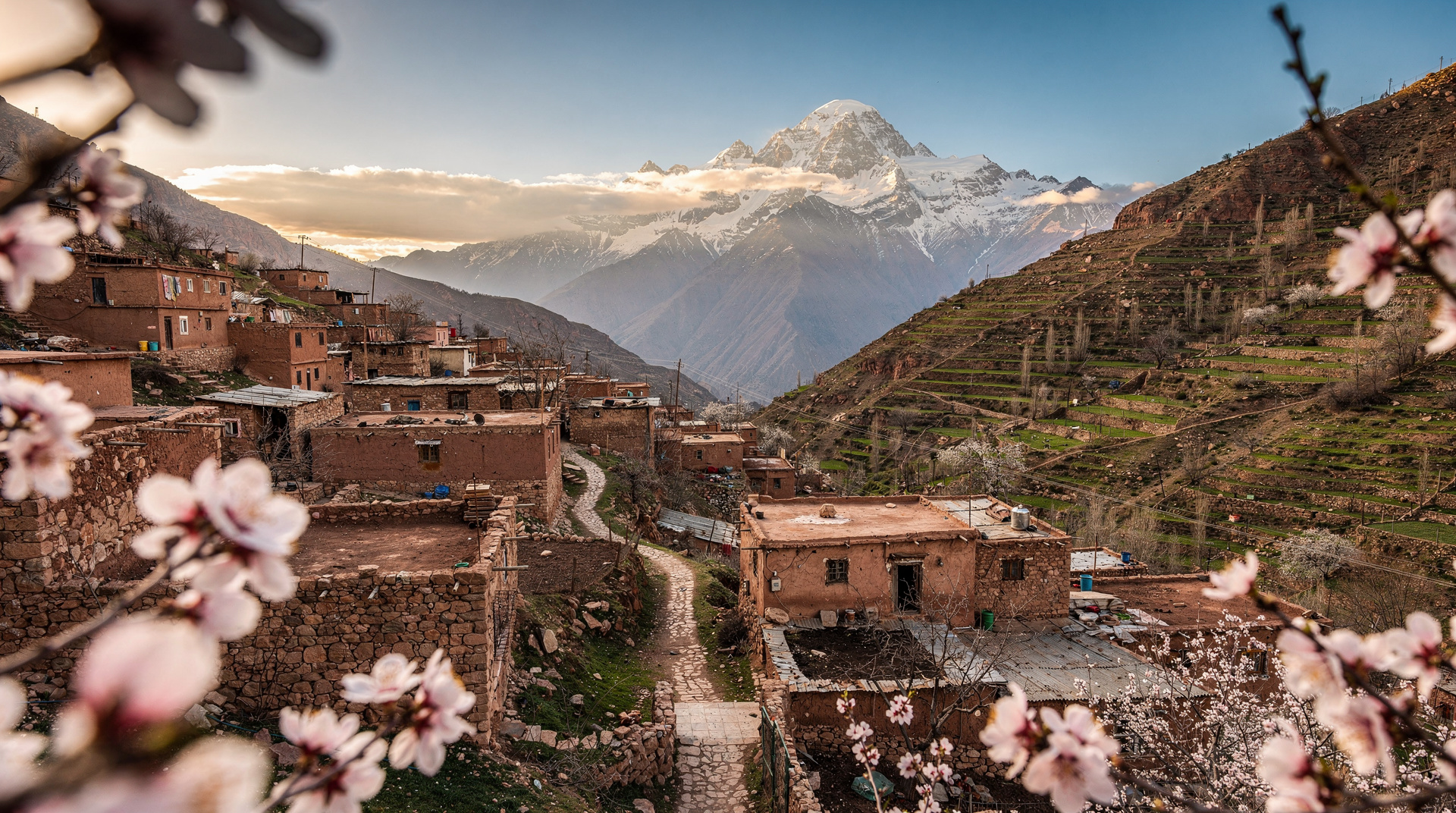
The Anti-Atlas doesn’t appear on most Morocco itineraries. It lacks the High Atlas’s altitude drama, the Sahara’s infinite sand, and the medinas’ cultural intensity. What it has is something harder to find in Morocco: genuine remoteness, rock formations unlike anywhere else in the country, a unique pink-granite landscape, and one of the world’s most reliable almond blossom spectacles in February.
Travellers who find their way here — typically driving a loop through Taroudant, Tafraoute, and back toward Agadir or Ouarzazate — consistently rank it among Morocco’s surprises. The absence of significant tourist infrastructure is simultaneously the difficulty and the appeal.
| At a glance | |
|---|---|
| Where | South of the High Atlas, centred on Tafraoute, 2.5 hours from Agadir |
| Getting there | Rental car essential; no useful public transport for independent exploration |
| Time needed | 2-3 days minimum for Tafraoute and the Ameln Valley |
| Best time | February for almond blossom; October-November for trekking comfort |
| Cost | Around 600-1,200 MAD/day for two, including accommodation, meals, fuel |
Where the Anti-Atlas is
The Anti-Atlas extends roughly 500km from the Atlantic coast (near Tiznit) southeast toward Ouarzazate, running parallel to and south of the High Atlas. The mountains here are older and geologically different from the High Atlas — rounder, more eroded, with a predominantly reddish and pink granite character rather than limestone.
The highest point (Jbel Aklim, 2,531m) is lower than Toubkal but the terrain is more dramatic in texture: great rounded domes of granite, boulder fields, river valleys lined with date palms, and the occasional flat-topped mesa.
Base for exploration: Tafraoute (1,200m elevation) is the natural base — the only town with adequate accommodation, restaurants, and services in the central Anti-Atlas.
How to get there:
- From Agadir: 150km southeast (2.5 hours) on the N10 and P7247
- From Tiznit: 107km east (1.5-2 hours) via Igherm
- From Ouarzazate: approximately 300km west (4-5 hours) via Taliouine
- No public transport of useful frequency; a rental car is essential for independent exploration
Tafraoute: the pink town
Tafraoute is a small town (population approximately 6,000) positioned in a natural bowl surrounded by pink granite mountains and almond orchards. The town itself is modest — a central square, a few streets of shops, several riads and guesthouses — but the setting is exceptional. Early morning and late afternoon light on the granite turns the surrounding mountains from pink to deep orange.
What to see in and near Tafraoute:
Amenagement des Ameln: The valley immediately north of Tafraoute, running toward the Ameln Valley, is a classic cycling or walking route through argan trees, almond groves, and scattered Berber villages. The 20km loop can be walked in 5-6 hours or cycled in 2-3 hours.
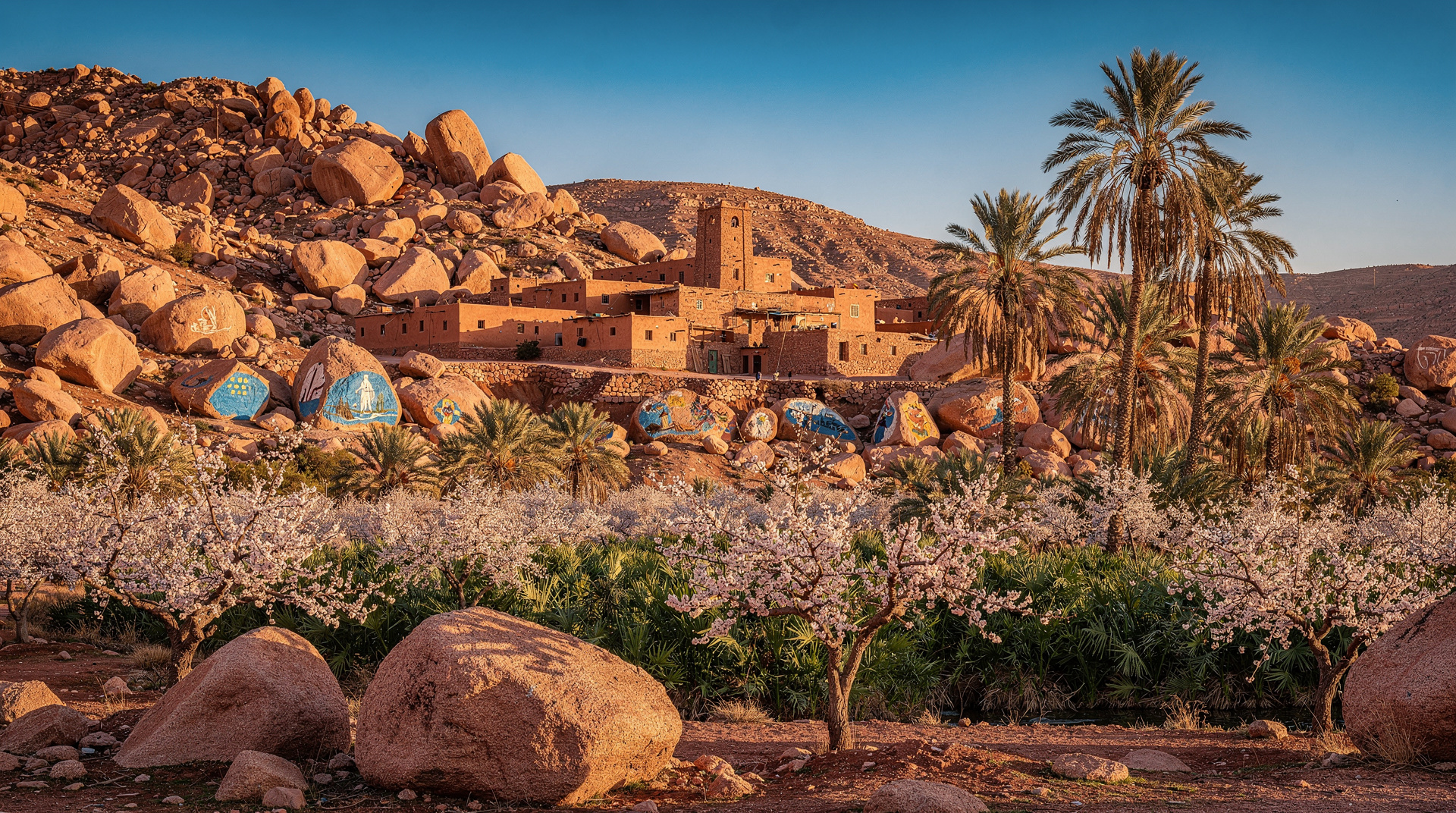
The painted rocks (Les Rochers Peints): Belgian artist Jean Vérame painted a collection of granite boulders in the valley south of Tafraoute in 1984, with local authorities’ blessing. The result is surreal: massive boulders in blue, red, and purple against the desert landscape. Some visitors love it; others find it jarring. Either way, it’s worth a 30-minute detour — turn south from the main road approximately 5km from Tafraoute town centre, following signs.
Agard Oudad: A large, spherical rock dome north of Tafraoute, considered sacred by locals. The walk to its base takes 20-30 minutes from the road and the granite texture at close range is impressive.
Tagmoute: A village 10km south of Tafraoute with a well-preserved agadir (collective fortified granary) — this type of fortified storage structure is unique to the Souss region and the Anti-Atlas and a good example of pre-Islamic Berber agricultural infrastructure.
The Ameln Valley
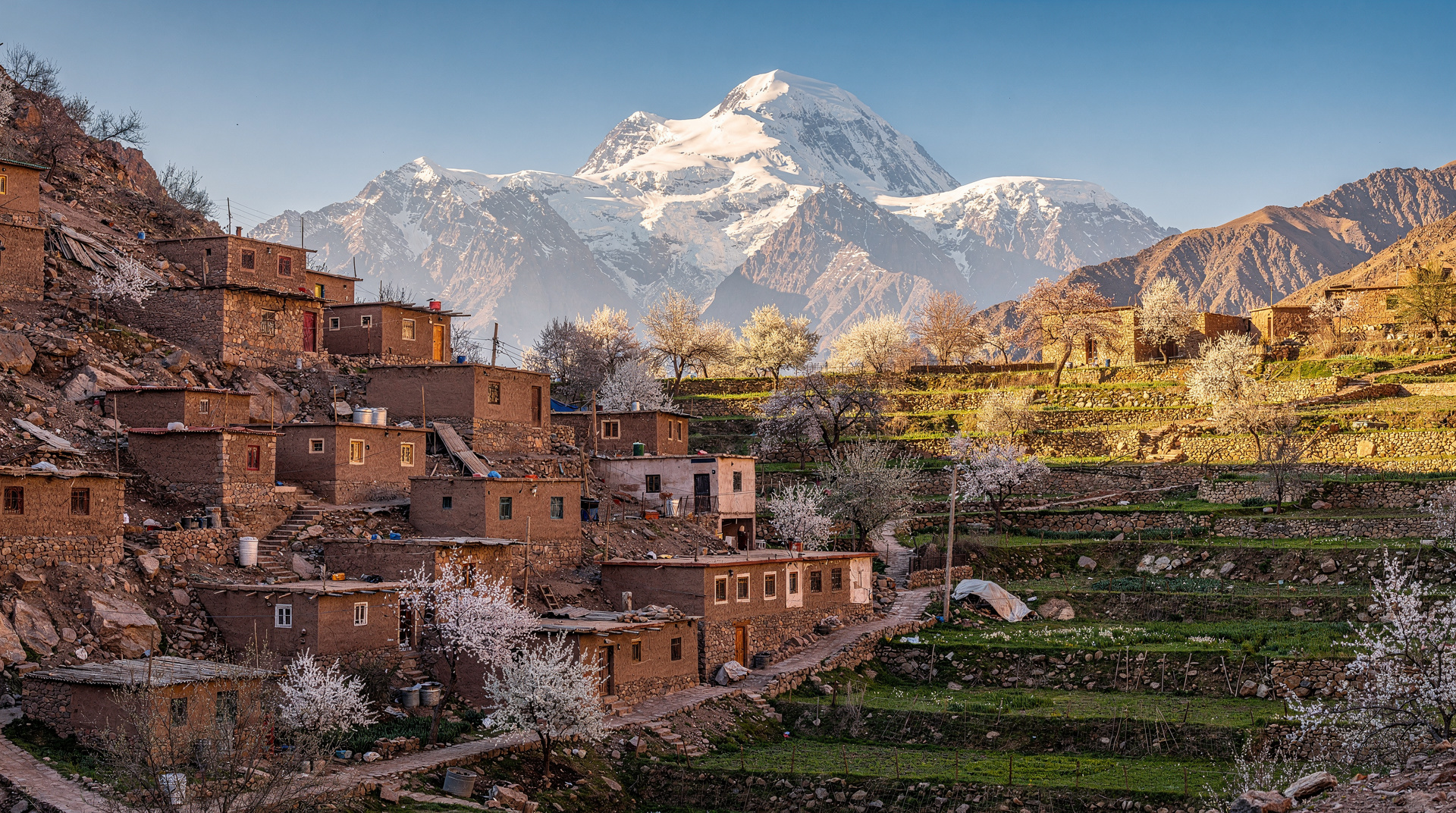
The Ameln Valley extends northeast from Tafraoute for approximately 30km, containing 26 traditional Berber villages (the Ameln confederation) scattered across the valley floor and lower slopes. Many are partially abandoned as younger generations move to cities, but a significant portion remain inhabited and genuinely functioning agricultural communities.
The villages share a common architecture: flat-roofed houses in whitewashed stone, narrow lanes between high walls, a central mosque, and communal threshing areas surrounded by terraced almond and fig orchards.
Best villages to visit in the Ameln Valley:
- Oumesnat: Probably the most visited — well-preserved, with a house traditionally open for tourist visits demonstrating traditional domestic life
- Aït Mansour gorge: Not technically in the Ameln Valley but nearby, a dramatic palm-filled canyon that rewards 2-3 hours of exploration
- Ikhf n’Ougham: A ridge-top village with exceptional views over the valley
The Ameln Village Women’s Cooperative: Several villages in the valley have argan and almond oil cooperatives run by local women. These are genuine production facilities (not tourist-market fronts) and worth a visit for context on the local agricultural economy.
Almond blossom season (February)
February transforms the Anti-Atlas. The almond trees that cover every valley floor and terrace in the Tafraoute area bloom simultaneously, typically in the last two weeks of February (exact timing varies by 1-2 weeks depending on that year’s winter temperatures).
The effect, at its peak, is extraordinary: the entire Ameln Valley turns white and pale pink with blossom, the pink granite rock faces behind provide a vivid colour contrast, and the air carries a light almond scent on warm afternoons. This is one of the most photogenic natural events in Morocco and yet remains almost unknown outside specialist photography circles and Moroccan domestic tourism.
Practical details for the blossom visit:
- Timing: Check locally — Moroccan agricultural websites and Tafraoute guesthouse operators track the bloom advance and can advise on peak weeks
- Best photography windows: Golden hour in early morning (8-10am) with low light raking across the valley; late afternoon (4-6pm) with backlighting through blossom branches
- Crowds: Moderate during peak blossom. Moroccan families visit from Agadir and Casablanca on weekends; weekday visits are quieter
- Accommodation: Book 3-4 weeks in advance for the prime blossom weeks — Tafraoute’s limited accommodation fills quickly
Remote Berber villages beyond Tafraoute
The roads radiating from Tafraoute lead into progressively more remote terrain with smaller, less-visited villages:
Jebel el Kest (south): A volcanic plug rising 1,800m from the valley floor, visible from Tafraoute. The road toward it passes through Ait Bou Oulli and Taghzout — small communities with virtually no tourist traffic. The ascent of Jebel el Kest is a demanding half-day hike; the approach drive alone offers exceptional landscape photography.
Tiznit direction (west): The road from Tafraoute toward Tiznit winds through a dramatic canyon section before reaching the plains. The Anti-Atlas villages in this direction — Souk el-Had, Tlata Aglou — are pure local market towns without tourist infrastructure.
Tata direction (east): The N10 east from Tafraoute toward Igherm passes through the Igherm plateau (1,800m), with views south toward the pre-Saharan plain. The Agadir Tasguint ancient fortified granary, between Igherm and Tata, is a remarkable example of collective fortified architecture from the 16th-17th century.
Cultural context: the Sous Berbers (Chleuh)
The Anti-Atlas is Chleuh Berber territory — the Souss region Amazigh people who speak Tachelhit (the Souss-specific Berber language, distinct from the Tamazight of the Middle Atlas and the Tarifit of the north). Cultural differences from Morocco’s Arabic-speaking cities are significant:
- Language: Tachelhit is the primary language in rural Anti-Atlas communities; Arabic is widely spoken in towns; French in educated settings
- Social structure: Extended family and tribal networks (the Ameln confederation represents one such structure) remain functionally important in village governance
- Architecture: Flat-roofed construction, agadir collective granaries, decorated doorways with geometric Amazigh patterns
- Economy: Argan oil, almond, and saffron production (Talouine, east of Tafraoute, is Morocco’s saffron capital)
Practical information
When to go:
- February (almond blossom, primary reason for most dedicated visitors)
- October-November (excellent trekking conditions, comfortable temperatures)
- March-May (spring flowers, good light, fewer visitors than February)
- Avoid July-August (temperatures regularly exceed 40°C)
Where to stay in Tafraoute:
- Dar Infiane: A guesthouse in the Ameln valley with Atlas views and genuine local character
- Les Amandiers (Hôtel): Older hotel but reliably comfortable, pool, good Anti-Atlas views
- Riad Tafraoute: Small riad in town centre, 5-6 rooms, family-run
Budget for accommodation: 300-500 MAD (30-50 EUR) per night for a comfortable guesthouse; 600-900 MAD for something better.
What to budget per day: 600-1,200 MAD (60-120 EUR) for 2 people including accommodation, meals, and fuel for day drives.
Connecting the Anti-Atlas to the broader itinerary
The Anti-Atlas works best as part of a southern Morocco loop rather than a standalone detour. Common routing:
From Agadir: 2-3 days in the Anti-Atlas (Tafraoute base), then either north to Essaouira or east toward Ouarzazate and the desert. If you want a warm-up day before driving into the Anti-Atlas, the Paradise Valley day trip from Agadir with lunch — a full day into the pre-Atlas gorges and palm oasis, from €35pp is an excellent introduction to the landscapes you’ll be entering.
The southern loop: Marrakech → Tizi n’Test pass → Taroudant → Tafraoute → Taliouine (saffron) → Ouarzazate → Marrakech. This is a 7-10 day loop covering the best of southern Morocco without the desert.
Those starting the loop from Marrakech will find the Berber village and Atlas Mountains day trip from Marrakech — a full-day introduction to mountain communities before the longer Anti-Atlas drive south a good first day out of the city. For a version that includes the Sahara, extend by 3 days to Merzouga. The 10-day Morocco itinerary has a variant of this loop.
Souss-Anti-Atlas destination context: The Souss and Anti-Atlas destination guide covers the full region including Taroudant, Tiznit, and the Souss plain.
Frequently asked questions about Anti-Atlas guide
Do I need a 4x4 for the Anti-Atlas?
Not for the main routes. The road network around Tafraoute and through the Ameln Valley is paved (though sometimes narrow and occasionally rough). A rental car handles it without issue. True off-piste exploration toward remote villages requires a 4x4 or high-clearance vehicle.
Is it safe to visit remote Anti-Atlas villages?
Yes. Safety in Morocco’s rural mountain areas is consistently good. The main consideration is cultural respect — ask permission before photographing people, dress modestly in villages, and accept offered mint tea as part of normal social interaction.
How many days does Tafraoute need?
Two to three days is ideal. One day for Tafraoute town and the painted rocks, one day for the Ameln Valley villages, and optionally a third for a longer hike or the Aït Mansour gorge. A one-day visit gives you the highlights but feels rushed.
Is the Anti-Atlas suitable for independent travel without a guide?
Yes. The landscape is open and the roads are clear. A guide adds value for village introductions and cultural context but is not logistically necessary. Local guesthouse owners can suggest routes and make informal introductions to village contacts.
How does the Anti-Atlas compare to the High Atlas and the Sahara?
| Anti-Atlas | High Atlas | Sahara | |
|---|---|---|---|
| Landscape | Rounded pink granite, open valleys | Steep limestone peaks, deep gorges | Dunes and hammada plains |
| Crowds | Very light, even in peak season | Moderate to heavy near Toubkal/Imlil | Heavy on the main Merzouga/Zagora routes |
| Best for | Almond blossom, remote villages, driving | Serious trekking, Toubkal summit | Camel treks, stargazing, dunes |
| Access | Rental car, 2.5-5 hrs from Agadir/Marrakech | Easy day trip or overnight from Marrakech | Full-day drive from Marrakech or Fes |
For a fuller sense of how the ranges differ in practice, the Atlas vs Sahara comparison guide walks through the trade-offs in more detail, and Merzouga vs Zagora covers the two main Sahara gateway routes if you’re extending the trip that far.
Food and where to eat in Tafraoute
Tafraoute’s dining scene is modest but genuine. Most guesthouses and gîtes serve home-cooked tagine and couscous as part of a half-board arrangement, which is usually the best food available — there are few standalone restaurants of note in town. The local specialty worth seeking out is amlou, the almond-argan-honey paste eaten with bread at breakfast; several shops in town sell it fresh, made from almonds grown in the surrounding orchards.
If you’re combining the Anti-Atlas with an argan oil cooperative visit, Tafraoute’s almond and argan overlap makes for a natural pairing — ask your guesthouse about a nearby cooperative before you arrive, since options are more limited here than on the busier Essaouira-Agadir corridor.
Planning around the Anti-Atlas
The Tafraoute destination page gives a closer look at the town itself, and the Anti-Atlas trek guide is the place to go if the walking routes around the valley appeal more than the driving. If you only have a day for the area from the coast, the Tafraoute day trip from Agadir shows how the highlights can be sequenced, though this page’s advice still stands: two or three nights is kinder to the landscape.
Because there is so little public transport, read getting around Morocco before you commit to a routing, and compare the options in private tour vs self-drive if you are unsure about driving mountain roads yourself. The best time to visit Morocco overview helps you place the almond blossom or autumn trekking window within the wider year.
Visitors interested in the people behind these villages will find useful background in the Berber culture guide, and photographers should look at photography locations in Morocco alongside the photography etiquette guide before pointing a camera at anyone in a village.