Chefchaouen: what Instagram shows versus what you actually find
| At a glance | |
|---|---|
| Where | Chefchaouen, Rif mountains, northern Morocco — around 4 hours from Fes, 3 hours from Tangier |
| Cost to see it | free to walk the medina; guided tours and day trips run roughly €30-60 per person |
| Time needed | 2 nights minimum to see it beyond the midday crowds |
| Getting there | grand taxi or CTM bus from Tangier, Fes, or Chefchaouen day-trip tours from either |
| Best time to photograph it | before 8am or after 8pm, avoiding the 10am-5pm tourist-bus window |
The photograph that started everything
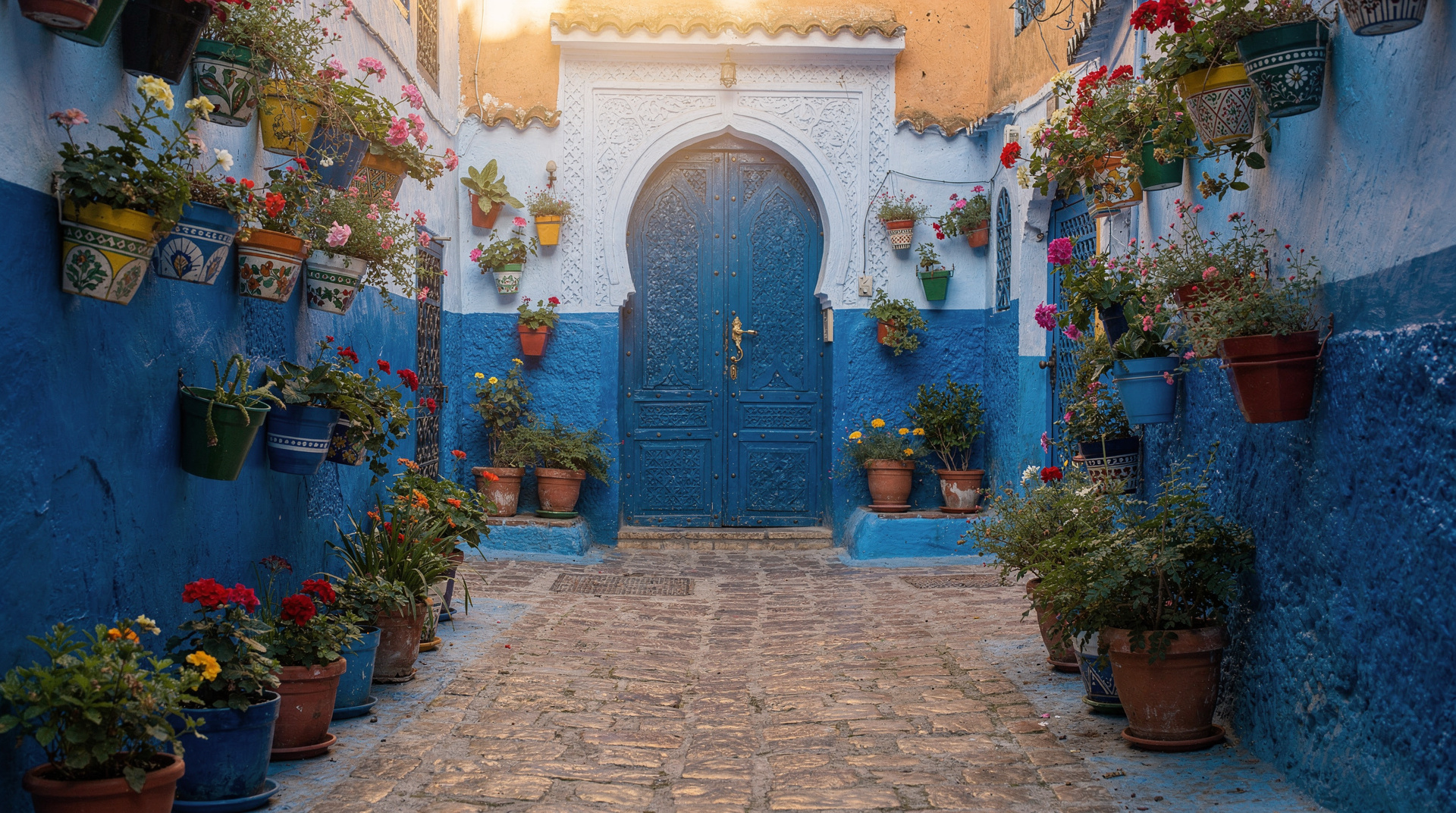
Somewhere around 2015, Chefchaouen appeared on Instagram. Not for the first time — the blue city had been photographed since the 1970s when it became a hippie destination — but in the specific Instagram way: a narrow blue alleyway, a cat sitting precisely in the middle distance, light falling from the left at a 45-degree angle, 47,000 likes.
The photograph was truthful. Chefchaouen really does look like that. The alleyways of the medina really are painted in those exact shades of blue — indigo and cobalt and washed-out chalk-blue and something closer to grey that photographs as blue — and the cats really do sit in them. The problem was not the photograph. The problem was the scale of what followed.
In 2013, Chefchaouen received somewhere around 200,000 visitors per year. By 2019, official estimates put the number above 800,000. The town has about 45,000 permanent residents. Every single iconic alleyway — the Uta el-Hammam square, the steps below the Bab Souk gate, the blue passage near the Spanish Mosque — now has a queue. Not a loose, informal cluster of people wandering past, but a managed line of visitors waiting their turn for the angle that the Instagram photograph taught them to want.
I have been to Chefchaouen three times: once in 2014, once in 2018, and once in 2021. They were three different experiences of the same city.
What I saw in 2014
A working Rif mountain town that happened to be blue. The medina was full of life that was not organised around tourism — women in traditional dress doing their shopping, men in the main square playing cards, the smell of kif drifting from the upper quarters, a goat in an alleyway that seemed as surprised to see me as I was to see it.
There were guesthouses and a few riads. There was a tourist trade — people buying handicrafts, eating at the restaurants around Uta el-Hammam, doing the hike to the Spanish Mosque for the view. But the tourism sat alongside the local life rather than replacing it. You could photograph the city because it was beautiful and not feel that you were participating in a managed performance.
The blue itself was different in 2014 — older, more faded, painted at different times by different people, so that no two adjacent walls were quite the same shade. There was a slightly patchy quality to it, like a city that had been painting and repainting itself for decades without any central authority deciding what colour everything should be.
What I saw in 2018
The patchy quality was gone. Between my two visits, a concerted effort had been made — apparently at a municipal level — to standardise and refresh the blue. New paint. Brighter paint. More consistent paint. The city was visually more striking and less interesting.
The tourist accommodation had expanded dramatically. The number of riads and guesthouses in the medina had doubled or tripled. New restaurants had opened on every street adjoining the main square. A significant proportion of the shops that had previously sold things Moroccan people buy — food, hardware, clothing — had been converted to handicrafts, blue-painted pottery, and “Chefchaouen” branded merchandise.
The cats were still there. There were, if anything, more cats, because cats are good for Instagram and it is reasonable to suspect that the local understanding of this is not entirely unconscious.
The Spanish Mosque hike — a 45-minute walk above the town with panoramic views of the blue medina below — was still excellent. This is where I would send anyone visiting: above the town, looking down, in the early morning before the tour buses arrive. The view from above is what the Instagram photograph cannot capture.
What I saw in 2021
Post-pandemic, there was a brief window — roughly March through June 2021 — when Chefchaouen had fewer visitors than at any point since before the Instagram boom. This was when I went. The town I found was somewhere between 2014 and 2018: the tourist shops were still there, the guesthouses were still there, the painted walls were still standardised. But the absence of the crowds meant I could walk the alleys in relative peace and look at what was actually in them rather than managing my position relative to other photographers.
What I found was still beautiful. Genuinely beautiful. The blue against the white of the walls is a real aesthetic achievement, whether it was designed for tourism or not. The town’s setting — in a cleft between two peaks of the Rif mountains, with the hills above it forested — is striking. The medina, even standardised, has good architecture: carved wooden balconies, tilework in the doorways, courtyards glimpsed through open gates.
The Spanish Mosque was still excellent.
The problem by 2021 was that even in reduced-crowd conditions, the town felt like it was performing. The arrangements of pottery in the alleyways, the cats positioned near photogenic doors, the old men sitting in specific locations — all of it had the quality of a curated experience rather than a live one. This is not a complaint, exactly. It is just an observation about what a place becomes when its primary economic function is being photographed.
What is still genuinely charming
The setting: The Rif mountains around Chefchaouen are beautiful and mostly unvisited by international tourists. Hike above the town in any direction and within fifteen minutes you are in landscape that has no connection to Instagram at all.
The Spanish Mosque view: Go at 7 am. Take the path from the upper medina. In the morning light with the mist in the valleys, it is the best thing about Chefchaouen and still relatively uncrowded at that hour.
A private walking tour of Chefchaouen with a local guide is excellent for exactly this reason — a good guide takes you to the lesser-photographed quarters and the viewpoints that require local knowledge to find.
The late evening medina: By 8 pm, the day-trippers from Fes and Tangier have mostly gone. The medina in the evening — lit by the lights of the restaurants and the string of lanterns around the main square — is genuinely pleasant. Eat dinner. Walk the alleys when they are empty.
The Akchour waterfalls day trip: An hour outside Chefchaouen by grand taxi, the Akchour gorge and its waterfalls offer some of the best day hiking in northern Morocco. This is where Chefchaouen visitors should spend their most outdoorsy half-day.
A guided day trip to Akchour from Chefchaouen is the best way to do this, since the paths require some navigation and the waterfall pools are significantly better with someone who knows which ones are worth the scramble.
The food: Chefchaouen’s restaurant scene is quieter and less tourist-oriented than Marrakech’s, and the local specialties — the Rif-style couscous, the goat meat preparations, the wild herb teas — are worth exploring with intention. The Rcif restaurant near the main square is a longstanding local recommendation.
What has been genuinely overrun
The famous alleys at midday: El-Ain alley, the steps near the Spanish Mosque’s lower approach, the alleys around Bab Souk — from 10 am to 5 pm these are genuinely crowded. Not “oh, other tourists” crowded, but “queue for the photograph” crowded. If you go at those times and expect the serene blue city of the Instagram, you will be disappointed.
The handicraft market: The traditional craft economy of Chefchaouen has been almost entirely replaced by tourist merchandise. You can buy blue pottery, blue-painted wooden items, blue-everything branded as Chefchaouen. Finding traditional Rif crafts — the weaving, the terracotta, the local spices — requires effort and specific guidance.
The main square after 11 am: Uta el-Hammam is still a beautiful space with a functioning mosque, an old kasbah, and decent restaurant terraces. It is also routinely at tourist density by 11 am in peak season, with the result that sitting at a café there feels like sitting in a busy airport café rather than a mountain town square.
The honest conclusion
Chefchaouen is still worth visiting. Not for an Instagram photograph you have already seen fifteen thousand times, but for the setting, the mountain surroundings, the Akchour hike, and the early morning and evening hours when the town returns to something like itself.
Go for two nights, not one. Stay in the medina. Be at the Spanish Mosque before 8 am. Do the Akchour trip. Eat dinner in the square when it is quiet.
Manage your expectations: you are visiting one of the most photographed places in Africa. Some amount of tourism saturation is simply the condition of arrival. The question is whether, under the saturation, there is still something worth finding. In Chefchaouen, the answer is yes — but you have to look slightly past the photograph to find it.
Our northern Morocco itinerary builds Chefchaouen into a wider Tangier-Fes circuit that puts it in its proper geographic and cultural context.
Beyond the photograph: other ways to spend your time
If the blue alleys are not enough to fill your stay, the town rewards slower exploration. Our Chefchaouen destination guide covers the practical side of the town itself, while the day trips from Chefchaouen guide lists the excursions that take you away from the busiest alleys. If you want somewhere to sleep that fits the quieter version of the town described above, the best riads in Chefchaouen are worth comparing before you book.
Shoppers who want to avoid the blue-branded merchandise will find more useful advice in our Chefchaouen shopping guide. And if you are still deciding between the blue city and the imperial one, the Chefchaouen vs Fes comparison sets out what each does best.
When to go, by season
| Time of year | Crowd level | Weather | Verdict |
|---|---|---|---|
| July-August | Very high (peak day-trip season from the coast) | Hot, 30-35°C | Worst combination — heat and crowds together |
| March-May | High | Mild, pleasant for hiking | Good but book the Spanish Mosque hike early |
| September-October | Moderate | Warm, comfortable | Best balance of light crowds and good weather |
| November-February | Low | Cool, occasional rain, cold mountain nights | Quietest medina experience, pack layers |
Getting the timing right within a single day
The pattern holds true regardless of season: Chefchaouen empties and refills on a predictable daily rhythm driven by day-trip buses from Tangier and Fes. Those buses generally arrive between 10am and 11am and depart by 4pm or 5pm. If your schedule allows only one full day, structure it around this window rather than fighting it — do the Akchour waterfalls day trip or the Akchour hike itself during the crowded midday hours, and keep the medina for your early morning and evening hours.
If you want to take photographs without adding to the crowding problem, our photography etiquette guide explains how to ask permission and behave around residents, and the first-time visitors guide puts a stop in the Rif into the wider shape of a Moroccan trip.
For onward planning, our Tangier destination guide and Fes destination guide cover the two most common gateway cities, and the best time to visit Morocco guide has the wider national picture if Chefchaouen is one stop on a longer trip.
Frequently asked questions about Chefchaouen
Is Chefchaouen worth visiting given how crowded it has become? Yes, if you go for at least two nights and plan around the 10am-5pm day-trip crowds. The early morning and evening hours, plus the Spanish Mosque hike and the Akchour waterfalls, are still genuinely uncrowded and worth the trip.
How many days do you need in Chefchaouen? Two nights is the practical minimum — enough for one full crowded midday (spent at Akchour or hiking) and both a quiet morning and a quiet evening in the medina itself.